

Telephone numbers involved in the avalanche in Ceuta on 30 and 31 July provided in the report elaborated by CENIF (National Centre for Immigration and Borders) provide certain relevant data.
In the report 40 telephone numbers are highlighted as animators, users and in some cases administrators of 19 different groupings which were active in the preparation and execution of the invasion that took place a couple of months ago.
All those groupings gathered, as a whole, the amount of 1,432 users. CENIF has identified 16 likely administrators. Interestingly, after profound research in open sources, there are three numbers which remain unlinked to any kind of identification, not even the least trace to any workable data. Among those three, it is to be highlighted the number +212755165476. This number is the probable administrator of one of the groups made up of 223 users. In addition to that, the telephone number is present in six different groups, which sum up to 349 users. The most interesting feature is that the number is not active in whatsapp anymore.
These are the relationships of the highlighted telephone number, according to the limited records exposed in the report by CENIF:
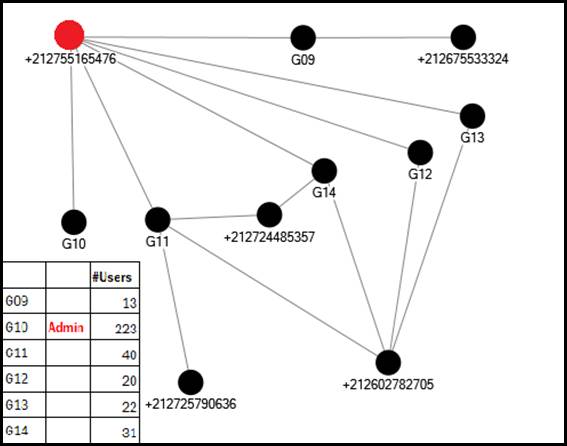
These connections indicate potential capacity to disseminate information within the documented network. The evidence presented does not establish the operator’s identity, actual mobilization activity or affiliation with an intelligence service but it’s a distinct and peculiar behavioural pattern. The reported absence of public identification and subsequent whatsapp inactivity remain observations requiring verification and explanation.
Some other telephone numbers are traceable to users (personal data will not be revealed) active in social networks and youtube channels. They usually belong to young individuals who even post messages showing criticism to the regime in Morocco. Some of them are associated with the “Gen Z 212” movement, which represents young Moroccans who see little prospect of a future in their country and are seeking opportunities abroad.
Locations where the telephones are allegedly located according to the gathered information vary from Tanger, Kenitra, Fez, Marrakech and Rabat to Beni Mellal.In any case, it’s highlighted that data indicates signs of an intelligence operation, being the most significant example the telephone remarked above. But it requires further investigation and data which remain in the hands of CENIF and other institutions.
Ideas on Morocco’s plans for Ceuta and Melilla
Morocco’s policy toward Ceuta and Melilla can be understood as a strategy to weaken their established economic model, increase their dependence on surrounding Moroccan regions, and expand Rabat’s long-term political leverage. The strategic objective is not necessarily immediate territorial change, but the gradual creation of conditions in which shared economic management—and potentially a role in questions of sovereignty—becomes more plausible.
The principal difference between the two cities lies in the balance between economic attraction and direct coercive pressure. Around Melilla, investment-led integration is the dominant mechanism; in Ceuta, border controls and migration pressure have played a more visible role.
The available public record supports an assessment of strategic pressure and economic competition, but it does not establish the existence of a single authenticated and comprehensive government plan to assume control of the cities. The analysis should therefore distinguish between documented measures, plausible strategic effects, and claims that remain unverified.
The common approach operates through three mutually reinforcing mechanisms:
- Reduce the cities’ function as commercial gateways into Morocco. Morocco closed Melilla’s commercial customs crossing in 2018, a step acknowledged by Spain at the time and partly justified by the development of trade through Nador’s port. The measure strengthened alternative Moroccan trade routes and reduced Melilla’s intermediary role.
- Develop competing centres of business immediately beyond the borders. Ports, airports, tourism projects and investment incentives in northern Morocco allow firms and consumers to operate through Moroccan infrastructure rather than through the Spanish cities. This development can redirect commerce, tourism and capital toward Nador, Tangier and Tétouan.
- Convert economic vulnerability into negotiating influence. Restrictions on commerce, border crossings and travellers’ goods increase uncertainty, while regional development makes closer economic integration appear increasingly attractive. Over time, this combination could provide Rabat with greater leverage in negotiations with Madrid. References to a horizon after the 2030 World Cup should nevertheless be treated as an analytical scenario rather than an agreed deadline or an accepted Spanish position.
The contrast between Ceuta and Melilla can be summarised as follows:
| Ceuta | Melilla | |
| Primary mechanism | Border restrictions and episodes of migration pressure can generate immediate political pressure on Madrid. | Development around Nador can draw commerce, tourism and investment into Morocco. |
| Surrounding infrastructure | Tangier’s ports and airport, the expanded Tétouan airport, and nearby tourism development. | Nador airport, Nador West Med, and the Marchica tourism project. |
| Strategic constraint | Morocco has demonstrated an ability to create acute border pressure. | Instability around Nador could undermine foreign investment that Morocco seeks to attract and protect. |
The lower level of migration pressure around Melilla is consistent with Morocco’s interest in protecting foreign investment and major development projects in the Nador region. This does not imply an absence of economic pressure around Ceuta; rather, it indicates a difference in the instruments used and in the costs Morocco would incur by destabilising each surrounding region.
For Melilla, the strategic logic is primarily economic. Marchica’s resorts, Nador’s transport links and surrounding investment could transform Melilla from an important regional gateway into a relatively small participant in a much larger Moroccan economic zone. If local firms become increasingly dependent on access to that economy, commercial interests may favour arrangements acceptable to Rabat. Such integration can generate political leverage, although it does not in itself transfer sovereignty.
For Ceuta, the strategic scenario is more directly associated with demographic, administrative and border-management pressure. One prospective model would involve a smaller city, a technologically controlled crossing and a reduced presence of Spanish public officials (the waning military presence works well in that direction). This illustrates how Ceuta’s existing model could be reshaped, but no official proposal demonstrates that a specific population target or administrative configuration has been adopted as policy.
There is stronger evidence that Ceuta has been used as an immediate pressure point. Following the May 2021 border crossings, the European Parliament explicitly condemned Morocco’s use of migration and border controls to exert political pressure on Spain. This supports the assessment that coercive instruments have been employed, but it does not establish that the episode formed part of an operation to annex Ceuta. The same goes for the avalanche in Ceuta in July 2026.
Pressure on Ceuta and Melilla can also serve Spanish-Moroccan negotiations on issues beyond the cities themselves. In particular, pressure against Ceuta may be used to seek further Spanish accommodation on Western Sahara, while a greater Moroccan role in the two cities remains a longer-term objective. Spain has already shifted its position by endorsing Morocco’s autonomy plan as the most credible basis for a negotiated settlement of the Western Sahara dispute. This supports a possible outcome involving autonomy under Moroccan sovereignty, while stopping short of explicitly recognizing Morocco’s existing sovereignty over the territory.
Two qualifications are essential to a balanced assessment. First, Morocco officially presents Nador West Med as a project for employment, competitiveness and regional development. Those objectives can coexist with strategic competition, but infrastructure investment alone does not prove an annexation plan. Second, the commercial-customs relationship has evolved: a restricted reopening occurred in 2025, so the record is not one of uninterrupted closure.
The least substantiated element is the conversion of economic influence into a formal role in sovereignty. The available evidence documents instruments of pressure, economic displacement and regional competition. It does not demonstrate an agreed mechanism through which Spain would surrender or share authority over Ceuta or Melilla.


Leave a Reply