
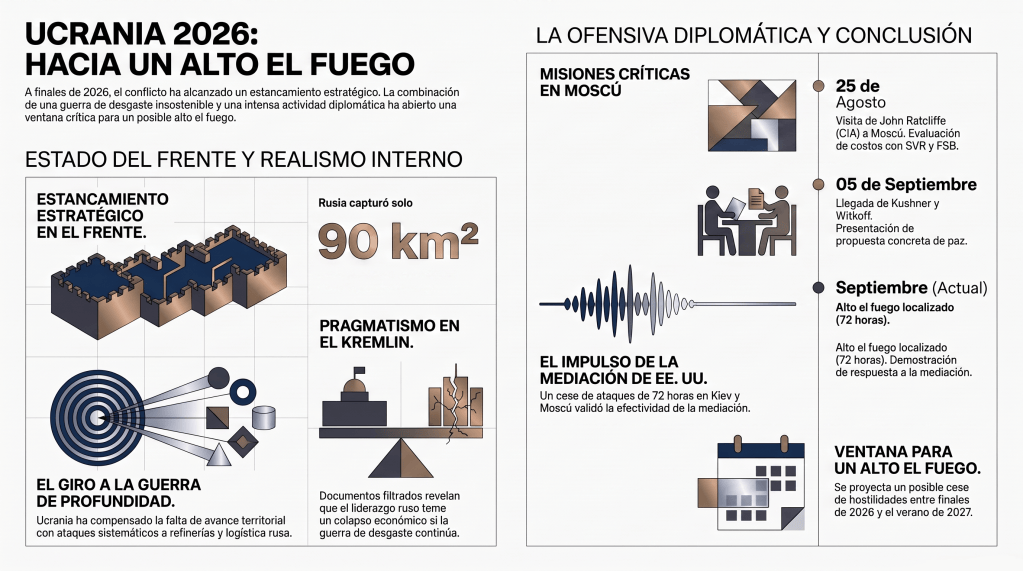
Se analiza el panorama del conflicto en Ucrania hacia finales de 2026, destacando un posible estancamiento militar y nuevas aperturas diplomáticas. El documento revela que el Kremlin maneja planes internos para una salida pragmática debido al desgaste económico, mientras que Ucrania ha fortalecido sus ataques tecnológicos y de largo alcance. Se detalla la mediación de enviados estadounidenses y jefes de inteligencia para negociar un alto al fuego que evite una movilización total en Rusia. A pesar de estos acercamientos, persisten obstáculos críticos como las disputas territoriales y la falta de garantías de seguridad definitivas para Kyiv. El texto concluye que existe una ventana de oportunidad para una tregua frágil entre 2026 y 2027, respaldada por una sofisticada estrategia de propaganda rusa para normalizar el fin de las hostilidades.
The landscape of the conflict in Ukraine towards the end of 2026 is analyzed, highlighting a potential military stalemate and new diplomatic openings. The document reveals that the Kremlin is managing internal plans for a pragmatic exit due to economic strain, while Ukraine has strengthened its technological and long-range attacks. It details the mediation efforts by U.S. envoys and intelligence chiefs to negotiate a ceasefire that avoids a full mobilization in Russia. Despite these overtures, critical obstacles persist, such as territorial disputes and the lack of definitive security guarantees for Kyiv. The text concludes that there is a window of opportunity for a fragile truce between 2026 and 2027, backed by a sophisticated Russian propaganda strategy to normalize the end of hostilities.
Mientras tanto los ataques en suelo euroeo por parte de Rusia presentan este aspecto:
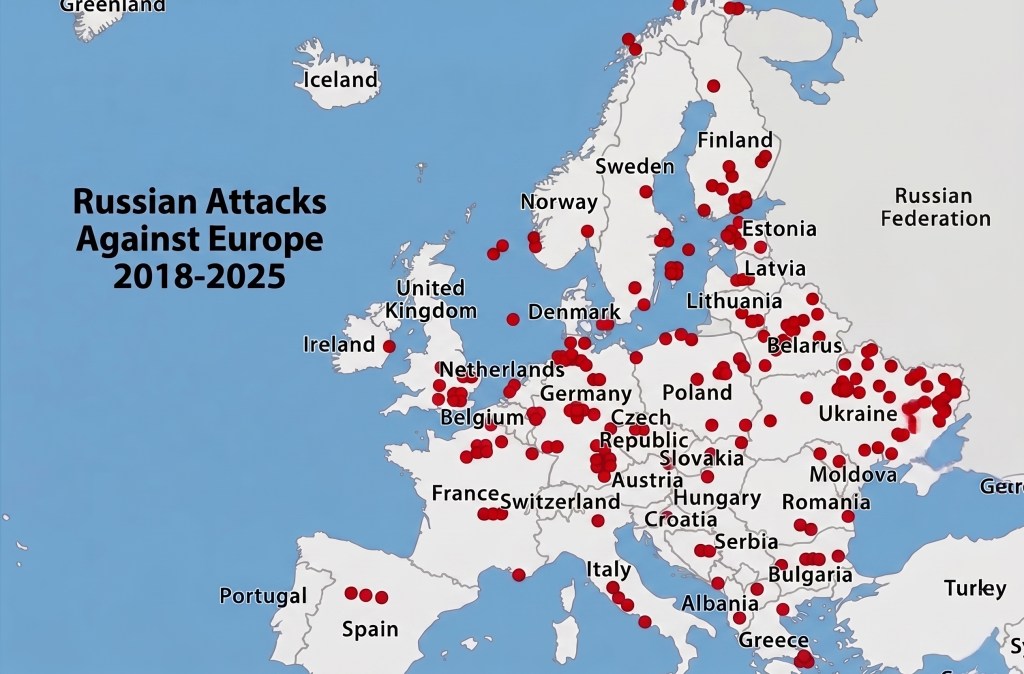
Los ataques rusos en suelo europeo son susceptibles de aumentar mientras se producen las conversaciones que pudieran llevar a un frágil cese de las hostilidades. Puede tardar meses.
Russian attacks on European soil are likely to increase while a cease fire is being cooked. But it may take months.
A summary in English:
And the report in English. Enjoy.
Dossier Centre has published a document which was demanded by the Deputy Chief of Staff of the Office of the President, Sergey Kiriyenko. In it, Russia draws a roadmap todeal with the end of the war in Ukraine. In the document is not stated that Russia won the war, but that the war is finished. It depicts the strategy to follow in order to sell the Russian people the reasons that had led to the end of the war.
The Kremlin has spent years maintaining a mobilisation narrative: existential confrontation, the West as adversary, sacrifice, heroism, territorial goals and the need to continue until objectives are achieved.
A negotiated end creates a problem. The population could reasonably ask:
If the enemy has not capitulated, Kyiv has not been taken and the political leadership in Ukraine remains, why was this a victory?
The document anticipates precisely this problem.
Its solution is to change the reference point against which victory is measured. Victory is no longer defined primarily as defeating Ukraine. It becomes:
Russia survived confrontation with the entire West; Russia preserved its sovereignty; Russia defended Donbas; Russia acquired territory; Russia demonstrated military resilience; Putin forced adversaries to negotiate; and the country emerged stronger and more independent. Those themes are explicit in the “image of victory” and “pride” sections.
This is politically sophisticated because it allows the endpoint to change without formally repudiating the original narrative.
The widening of the adversary from Ukraine to “the collective West” is particularly useful for that purpose. If Russia has effectively been fighting fifty countries, then merely surviving, retaining territory and forcing negotiations can be presented as victory.
Another striking characteristic is that the document does not seem surprised that different sides will describe the settlement differently.
It explicitly recognises that in the information environment the United States, Western countries and Ukraine will present their own version of the outcome.
Most likely end-users:
| Level | Probable recipient/function | Why the document fits |
|---|---|---|
| 1. Political-strategy core | Senior officials in the Presidential Administration’s domestic-policy bloc | It defines the political problem, segments audiences and establishes the master narrative. |
| 2. Political technologists / campaign managers | Kremlin-linked strategists, consultants and “social architects” | They would convert the framework into campaigns, polling, messaging and interventions. |
| 3. Information coordinators | Online-media managers, state-aligned media structures, communications contractors | Pages 9–10 specify concrete media and social-information products. |
| 4. Regional political administrations | Governors’ political teams and officials responsible for domestic policy | Many proposed narratives require coordinated nationwide implementation rather than a single national broadcast. |
| 5. Social implementation organisations | Veteran bodies, youth organisations, cultural institutions, educational and commemorative structures | The proposed measures include veterans, historical memory, memorials, educational projects and social reintegration. |
| 6. Senior Kremlin leadership | Possibly Putin/Vaino or a very small approval circle | They could be shown the strategic concept for authorisation, but the document’s operational detail makes them less likely to be the principal working audience. |
If Kiriyenko himself actually produced or personally approved this presentation, I would not identify Putin as the most likely immediate receiver.
The document reads more like downward strategic guidance than upward strategic advice.
Putin would not need a slide telling him that “armchair ultrapatriots” are emotionally difficult audiences and then listing media-project ideas. Those are implementation problems.
The more plausible immediate audience is therefore something like:
the senior political-technology and domestic-policy team below Kiriyenko, tasked with turning a presidential decision to end or freeze the war into a coordinated nationwide political communications programme.
From there, elements could be decomposed into instructions for polling organisations, regional administrations, media organisations, cultural institutions, veteran structures, political consultants and digital influence operators.
I would assign high confidence to the functional identification of the recipient as a political/communications-management apparatus, but only moderate confidence to any particular named office or individual, because the document does not contain a visible distribution list, addressee or organisational routing information.
The document is not merely preparing Russia for peace.
It appears to be preparing the Russian political system for the dangerous interval immediately after peace.
That makes the file particularly interesting as an intelligence document. It does not principally tell us what the Kremlin thinks the end of the war will look like. It tells us what the Kremlin authors apparently fear could happen inside Russia if the end of the war is not politically managed.


Leave a Reply