
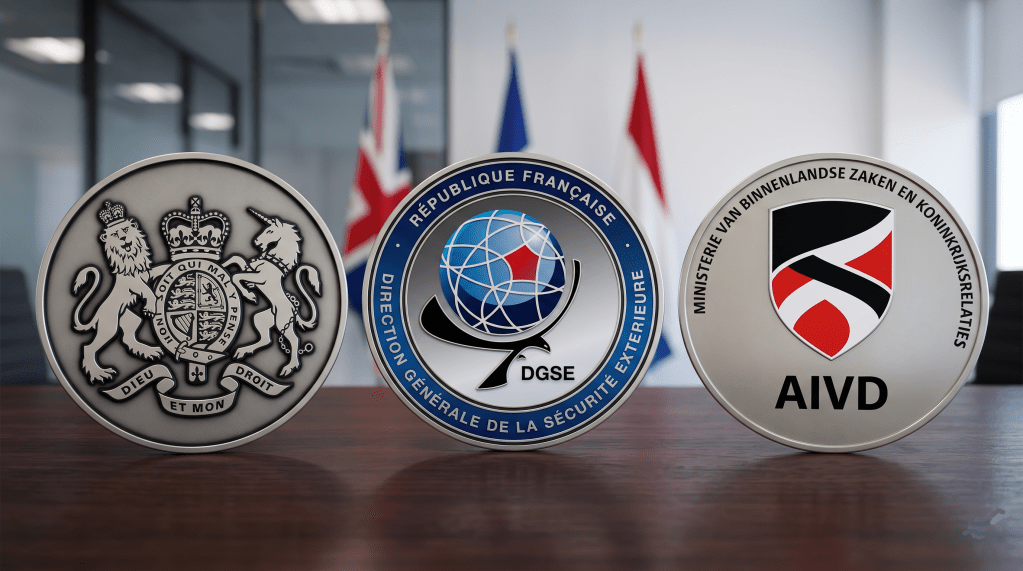
L’Express has carried out an unsual investigation regarding intelligence agencies in Europe. The outlet has counted on 60 experts on intelligence, including but not limited to serving and recently retired members of intelligence services. Among them over a dozen of leaders of those organizations.
Although opinions of experts are subjective, the profiles of the involved deserve some attention and respect. Despite the amount of expertise accumulated, some ideas might be argued. For instance, the rank given to the German BND should be reviewed. But, as a whole, the investigation open an interesting discussion. Paxconsulting has developed as well its own metrics to support or disregard some conclusions. The most striking are the huge differences (markings) of the intelligence agencies. Between the first and the second there are 82 points of difference.
The CNI ranks 12 among 25 services. It should lead to some reflection ar government level about the efficiency of the current intelligence environment in Spain. Here some hints about the CNI (en español).
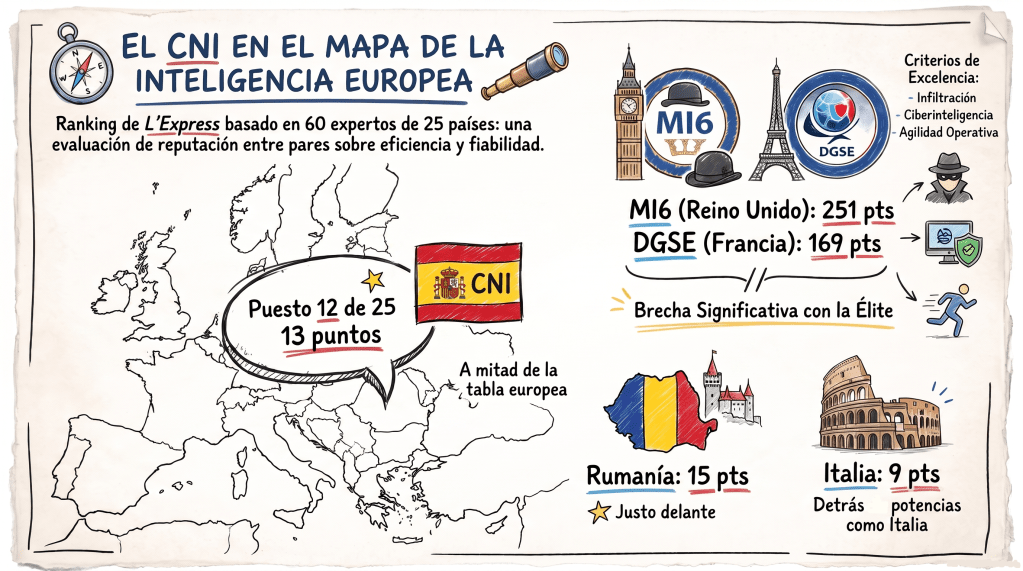
This document analyzes a peer-perception ranking of European intelligence services based on a survey of 60 current and former intelligence professionals from 25 countries. It identifies the UK’s SIS/MI6 as Europe’s leading intelligence service, emphasizing its long-term HUMINT strategy, elite recruitment pipeline, and strategic foresight, particularly regarding Russia’s 2022 invasion of Ukraine. France’s DGSE is ranked second for its global reach, integrated technical and human capabilities, counterterrorism strength, and African expertise, while the Netherlands’ AIVD is highlighted as a highly efficient “over-performer” due to its cyber capabilities and strong liaison relationships.
The broader argument is that European intelligence effectiveness increasingly depends on technological specialization, institutional independence, and operational culture. Smaller states such as Estonia and the Netherlands demonstrate that cyber, OSINT, and focused expertise can create influence beyond national size, while Germany’s BND, Poland, Slovakia, and Spain’s CNI are discussed as underperforming or politically constrained in different ways. The document concludes that MI6 remains the benchmark because it combines innovation, flexibility, elite talent, and an aggressive foreign-intelligence mindset, and it suggests that Spain’s CNI would need stronger resources, clearer foreign-intelligence orientation, and a more proactive operational culture to perform better.
The whole report in English. Enjoy.


Leave a comment