
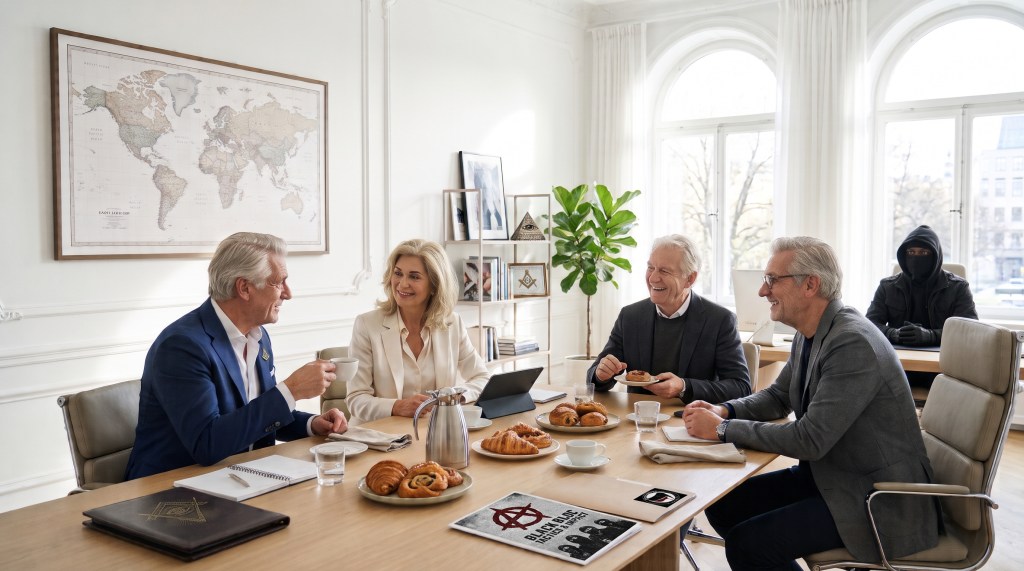
This post is not a thorough analysis on the topic. It’s merely a reflection on the theories related to the obscure goals pursued by the Soro’s Open Society Foundation (OSF).
And in order to address the issue we will compare it with the activities, as obfuscated as Soro’s, to say the least, according to some groupings, carried out by the Kremlin’s networks.
We cannot tell what the final goal of the Soro’s entourage is. However, OSF has always published the organizations it funds, the amount of money given or the grants and awards granted. In any case, OSF activities are traceable and there is consistency in the line of action.
OSF was built up to spread Popper’s idea of an open society:
| Actor | Core Worldview | View on Capitalism & the State | View on Religion & Identity |
| George Soros / OSF | Popperian Liberalism (“Open Society”) | Pro-market capitalism (regulated); supports liberal democratic institutions, courts, and NGOs. | Secular, pluralist, pro-LGBTQ+, feminist; Soros is of Hungarian Jewish origin and OSF recently pledged $30M to fight antisemitism and anti-Muslim hate. |
OSF openly funds human-rights, democracy, migration, and progressive causes worldwide; its grants are largely transparent via public databases.
Conservative and right-leaning sources frequently interpret this network as enabling or amplifying protests and social unrest (a recurring pattern also seen with migration crises, etc.). Mainstream and fact-check perspectives typically describe many “Soros paid the rioters” narratives as exaggerated or conspiratorial, noting the distance between general NGO grants and street violence, and the absence of proof of direct payments to participants or command-and-control.
It would be naïve to believe that all the money invested in funding organizations such as Amnesty International and alike through the OSF is done purposeless. What matters here is that it is traceable.
Soros and OSF seem to play nowadays the role granted to the Rothschilds in the 20th century. At least, that’s what is claimed by many.
OSF has also been told to fund all types of organizations with no backing of any type. Sometimes forgetting Soros’ origins and life experience (he survived Nazi invasion as a Jew and the Stalinist afterwards, as a democrat in Hungary).
Even with the current events in France, Italy and Spain, his name shows up as an instigator of violent protests.
If we take into account what we know so far about the funding of all types of groupings, irrelevant if they are far-right or far-left, carried out by the Kremlin in the West, there is an important distinction regarding the traceability of their funding.
What makes the Kremlin’s strategy effective is that it does not seek ideologically uniform partners, but rather anti-establishment leverage points. Internal documents from Russian influence operations (such as the Social Design Agency, or SDA) explicitly define their objective as “International Conflict Incitement”—escalating internal societal friction in Western democracies by fuelling opposing political fringes.
Following the “colour revolutions” in the post-Soviet space (such as Ukraine’s 2004 Orange Revolution), the Kremlin concluded that Western powers did not intervene through traditional military coups, but by funding and orchestrating youth movements, NGOs, and protests “from below”. To prevent similar contagion from overthrowing the regime in Moscow, the strategy devised within the presidential administration by Vladislav Surkov—who served as Deputy Chief of Staff of the Presidential Executive Office of the Russian Federation (1999–2011), Deputy Prime Minister (2011–2013), and adviser to President Vladimir Putin on relations with Ukraine and the post-Soviet space (2013–2020)—held that simply monopolising institutional power was not enough: it was also essential to secure a “monopoly on subversion”.
How it is implemented and whom it encompasses: rather than outlawing protest, the Kremlin actively recruited, funded, and instrumentalised radically opposed and marginal factions. These ranged from patriotic biker gangs (Night Wolves) to football hooligans, anarchist groups, skinheads, young communists, and ultra-conservative religious collectives on both the far right and the far left.
Those domestic relationships gave the Kremlin access to a vast network of contacts across Europe —far-right, far-left, neo-Soviet, and paramilitary— which it has continued to exploit ever since, with the ultimate aim of sowing instability in the West by fostering mistrust of the authorities, democracy, and its institutions.
The main difference lies on the fact that many of those groupings carry out their activities which require funds, with unclear financial support. They are organized in a federal and decentralized manner which makes it impossible to trace the source of their financial capabilities.
And that is the main difference with Soro’s network, so to speak. Of course, it doesn’t mean that tracking OSF activities and financial support is straight forward, but it is feasible. On the contrary, Kremlin’s networks are untraceable. Western government agencies get partial information from time to time and then those links are easily replaced and go underground again.
Groups contacted in Russia:
| Association / Group | Ideological Spectrum | Leadership | Role within the “Power Vertical” |
| Night Wolves | Far right / Patriotic neo-fascism | Alexander Zaldostanov (“The Surgeon”) | Patriotic shock force, urban youth mobilisation, and paramilitary volunteers in occupied territories. |
| National Bolshevik Party (NBP) | Syncretic (far left and far right) | Eduard Limonov | Infiltrated and instrumentalised as a safety valve to channel disaffected youth nihilism. |
| Liberal Democratic Party of Russia (LDPR) | Far right / Ultranationalism | Vladimir Zhirinovsky | Simulated parliamentary opposition, designed to absorb the radical protest vote. |
| Communist Party of the Russian Federation (CPRF) | Far left / Neo-Stalinism | Gennady Zyuganov | Junior partner of the regime that retains the Soviet-nostalgic vote without challenging the leadership of the power vertical. |
| A Just Russia / Rodina Party | Moderate left / Left-wing nationalism | Sergei Mironov, Dmitry Rogozin | Creations of the presidential administration intended to fragment and control the left and nationalist movements. |
| Essence of Time (Sut Vremeni) | Left-wing neo-Sovietism | Sergei Kurginyan | Ideological movement used to justify reconstructing the Soviet space within a neo-imperial framework. |
FINAL REFLECTION:
History shows the need of humankind to count on external forces which control or intend to determine our fate. I am not talking of religion but of powerful individuals or groups which try to dominate the way we live. Prophecies and messiah have always been awaited, accepted and rejected. It has evolved as time has gone by. Sects (illuminati for instance), masonry or more recently Bilderberg club, Trilateral commission and other power groups have been pointed at as the masterminds of the future of the world. The Rothschilds or now the Soros are part of that iconography societies create out of the blue to hate and love and keep moving.
Finding enemies, someone to fear and someone to attack, is key to gather people, build ideologies on it (sometimes ideology goes first and then the target is chosen) and go after a goal a few have set up. Critical thinking—especially when applied to ourselves—is key to keeping the big picture in sight.
Just as the gods of Olympus interfered with humanity in ancient Greece, contemporary power structures, real or invented, destabilize the everyday lives of individuals who require no further complications than those already imposed by existence.
Sources used as reference:


Leave a Reply