
Cuba is under a huge pressure. However, it is still standing. It counts on some international assets which should not be understimated, although realpolitik might induce to believe they are not that important.
Venezuela cannot support Cuba anymore. But it was not the only asset the island could count on. Although the role of Russia seems to be obscured by a certain understanding between Trump and Putin, realpolitik walks its own path, especially when leaders like Putin run a global power like Russia still is.
Trump and his administration might have thought that Iran was going to be as easy as Venezuela was. They were wrong. Cuba itself might not be walk the same path as Venezuela did because its friends have different interests from those in Venezuela, although Cuba and Venezuela share the same allies.
Venezuela was a surrogate of Cuba although it might have seem differently in the public eye. Maduro was a Cuban asset and it was him who introduced Cuban security in the country when serving as minister of Foreign Affairs under Chavez. Maduro’s security detail was made up of Cuban agents when he was taken by U.S. forces in January 2026.
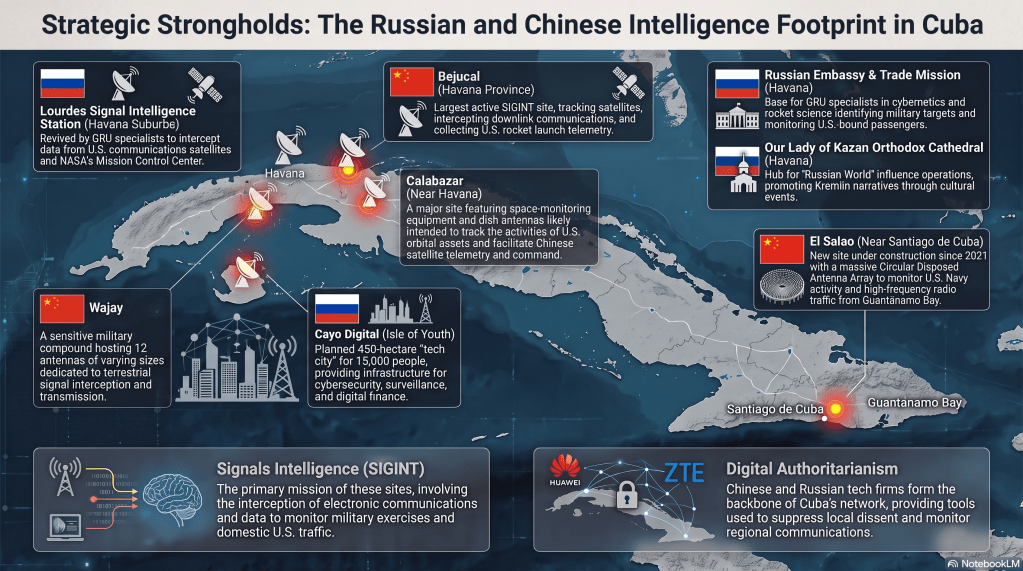
The document argues that Cuba is under severe economic and political pressure, especially after the collapse of its former oil-for-security relationship with Venezuela, and has increasingly relied on Russia, China and Iran to sustain the regime. It presents Cuba as a modern “forward operating node” for foreign intelligence activity, combining Russian HUMINT and technical expertise with Chinese telecommunications investment and SIGINT infrastructure. Key sites such as Bejucal, El Salao, Wajay and Calabazar are described as enabling surveillance of U.S. military, aerospace and communications assets, particularly across the Southeastern Seaboard, while external support also helps Havana maintain domestic repression through censorship, signal jamming and security coordination.
The document’s strategic assessment is that Cuba’s intelligence role is less a sign of strength than a high-risk survival strategy driven by regime fragility. It warns that Havana has effectively traded sovereignty for foreign economic, military and technological lifelines, creating regional risks for the United States, Colombia, Brazil and the wider Western Hemisphere. The final section broadens the analysis to Cuba’s soft power, arguing that Havana has long used ideological solidarity, revolutionary tourism, racial‑justice narratives, institutional front groups, education and medical diplomacy to cultivate international support, counter U.S. policy and build sympathetic networks abroad.
Here you have an analysis of Cuban intelligence environment which might provide a different approach to the situation. Enjoy.
Here a short summary in Spanish.
Here the analysis in English, Spanish, French and German.


Leave a Reply