
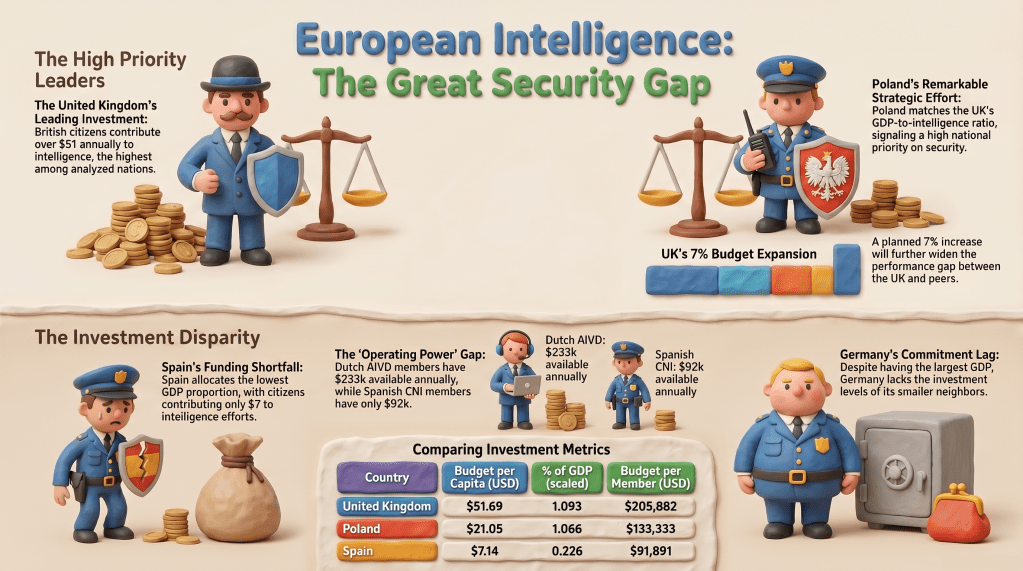
Across Europe, understandings of security—what it means, what it entails, and what it requires—vary considerably. Although European societies share a substantial common history, they have experienced that history through different political, social, and strategic realities, and their priorities have therefore diverged. The Second World War shaped European life for generations, and its effects remain visible today. Eastern and Western Europe lived through profoundly different post-war experiences, while countries such as Germany, Italy, Spain, and France each developed their own distinct historical memories. France, for example, was deeply divided between the legacies represented by Pétain and De Gaulle, a fracture powerfully explored in the documentary Le Chagrin et la Pitié. These divergent experiences have produced different security cultures, which in turn influence how governments assess threats, allocate resources, and define the role of intelligence agencies.
Here you have in different languages a report based on available data (open sources) in order to better understand the differences across Europe. Enjoy the read.
 Pax Consulting
Leave a comment