
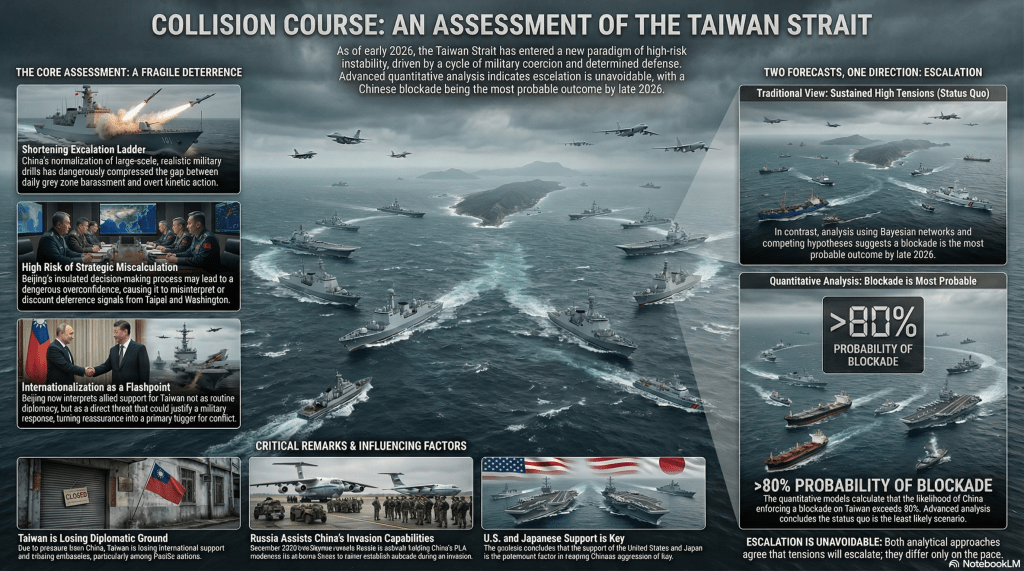
Happy New Year. As we open the first entry of 2026, the global landscape remains dominated by two critical flashpoints: Taiwan and Ukraine.
To evaluate these risks, we have employed a dual-methodology approach. While these frameworks operate on different logic, they have arrived at a sobering consensus.
I. The Methodologies: Traditional vs. Mathematical
Our analysis splits into two distinct schools of thought, each offering unique strengths and limitations.
1. The Traditional Approach (Bayesian & ACH)
This method utilizes Bayesian Networks to determine probability based on prior knowledge ($P(A|B)$) and the Analysis of Competing Hypotheses (ACH) to systematically weigh evidence.
- The Strength: It accounts for “soft” variables—human psychology, societal fears, and political willpower.
- The Bias: Because it is performed by human analysts, it often mirrors the hopes or anxieties of the society in which the analyst is embedded.
2. The Mathematical Approach
This is a cold, quantitative model that prioritizes data points over sentiment.
The Bias: It may overlook the “irrational” human decisions that can occasionally defy data.
The Strength: It is “emotionally blind.” It does not care if a result is frightening or politically unpopular; it simply follows the trendlines of logistics, economics, and military movements.
Despite their different lenses, both models converge on a single, unavoidable conclusion: Escalation in both Taiwan and Ukraine is inevitable this year. While the traditional approach warns us of the human cost and the societal impact, the mathematical approach confirms that the structural momentum toward conflict is already in motion. We must prepare for a year where theory meets a very difficult reality.
Enjoy the read.

 Pax Consulting
Leave a comment