
We have been tracking very closely the first decisions made by the White House after Trump got there. President Trump has not let us down. As expected, he has moved quickly. He has acted decisively to set in motion what he had been promising the US public while campaigning.
His first decisions were very much focused on migration and home affairs. But he has already started to get involved in foreign affairs. Tariffs have been a bold move to test the waters with Canada and Mexico. Of course, China went closely behind and the EU is already behind the next door. Canada and Mexico have been able to delay the swift move. But it really marks the very beginning of a negotiation. That’s clearly what Trump was looking for. Other countries such as PAnama or Colombia have been unable to get to this level. Both have complied with what Trump wanted. Colombia has accepted the return of migrants. Meanwhile, Panama has announced that the agreement with China will not be renewed.
These moves reveal the exercise of power that the US and Trump can deliver. They show Trump’s administration’s willingness to get what it wants by any means at its disposal. Weaker countries will have to comply with Trumps´s desires and bigger ones will be forced to negotiate. China is still reluctant to make any bold move. Filing complaints before international organizations is irrelevant before Trump.
Here at Pax, we have been gauging the impact that those decisions have on three different areas. First, we are focused on how it may affect in terms of a trade war with the EU. Secondly, we are tracking the effects it all may have on NATO. We are concerned about weakening the organization. Thirdly, we want to gauge if China is benefited, somehow, by those decisions.
So far, the most clear impact it all will have focuses on the EU. A trade quarrel with the US seems very likely and unavoidable. It will significantly impact prices in the EU. Consequently, it will also impact inflation in the EU. It will also affect the US. Trump has already mentioned publicly that it will cause some suffering in the short term. He is preparing his supporters for it, promising them better times shortly after.
Regarding NATO, it appears it cannot count on fair winds and following seas in the coming months. An increase in defense expenditure is being demanded by Trump but also by the organization itself. The Spanish government will be in dire straits to manage this situation. Trump has mentioned Spain on several occasions as a remarkable member of the Alliance for its low contribution. Mark Rutte has already visited the Iberian Peninsula. He went there to remind Spain and Portugal that they will have to increase their contributions. Therefore, it seems irrelevant that the most leftist side of the government coalition is not willing to comply. They are not ready to meet these demands. However, there will have to be more than a sign, more than words to avoid conflict within the Alliance. Besides, other important contributors, such as France or Germany, will push in the same direction.
But the great loser in this environment, is China. This country has not made any big move other than DeepSeek show of force. The Asian giant is keeping a low profile. The Panama issue and tariffs have not provoked any aggressive reaction so far. But it is the most important target picked up by Trump in every scenario we have been working on. It is, after all, a heritage of Biden’s administration.
Trump has always kept his word. What he has promised, has always been approached, tested or tried. He may find drawbacks on his way. Nonetheless, those topics are not left aside. This is true in spite of efforts carried out by the democrats, judges or social movements.
Although Trump has only been in office for less than a month, we can anticipate China will have a hard time with Trump. It will be a challenge for both, China and the United States. Trump knows the US enjoys some superiority in many fields over China. China cannot compete militarily or in international support. But it cannot challenge the US economically either. China has many challenges to deal with before confronting the US as a heavy weight. And many of its weaknesses have to do with the fact of being an autocracy.
NATO members will struggle with each other over their contributions to the alliance. Eastern European countries will support the idea. They have the threat of Russia over their shoulders. Northern European countries will also support it, thanks to the Russian flavour they have been tasting since 2022. Other members will keep their reluctance to increase their defense expenditure, mainly for political reasons. But they will be forced to do so. This cleavage will weaken the Alliance in the short term but it will be definitely accepted. The organization will bloom again.
The EU will face turbulent times with the US. Energy and agriculture are some of the many fields of controversy in the coming months. There will be ups and downs which will be reflected in the stock market. It will generate tensions that will harm the EU in terms of increasing instability in the markets. However, it will force the EU members to strengthen their relationships. This will happen if the European project is already too big to fail. After all, Trump will use tariffs as a bargaining chip. He will bring them to the table whenever he deems it necessary to get what he wants. It’s negotiation time for everyone under the auspices of Trump.
Foreign policy in the United States is regarded as a failure and detached from the needs of the country. And that is what Trump will try to mend: the perception the mean American has over the foreign relations which are deemed to serve their needs. Marco Rubio mentioned the mandate he had been given by the President. And it is as follows: do only whatever works in favour of the US, whatever makes the US safer, stronger and richer. All the rest is to be dropped.
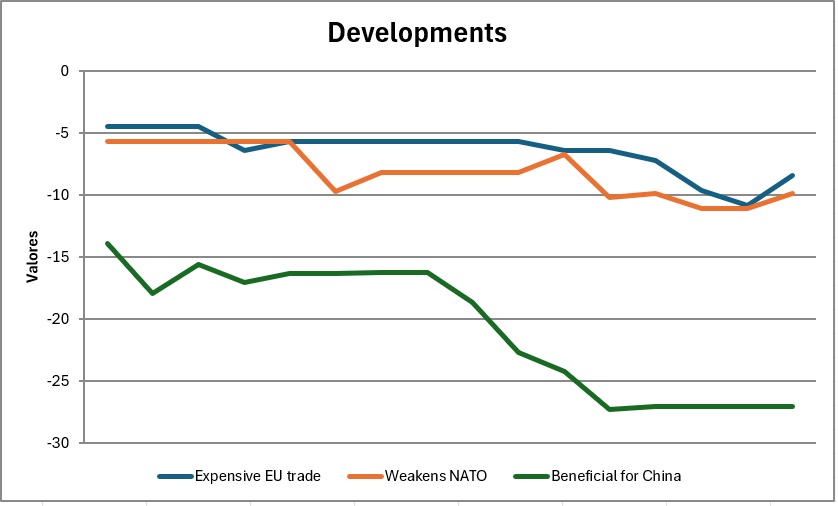
The graph starts depicting the current situation . It shows that China will experience challenges in the medium term (two year time). This will occur irrespective of unlikely events happening. These events include the removal of president Trump (death, illness) or the use of tactical nuclear weapons by Russia in the Ukraine conflict. These black-swan events are depicted on the right hand side of the graph.
It also shows that there is a correlation between the effects on the EU trade and the strength of NATO. If trade in Europe suffers, NATO is also weakened.
The graph makes it also very clear that the most likely environment will be a strained time for European trade and what it may bring along.
 Pax Consulting